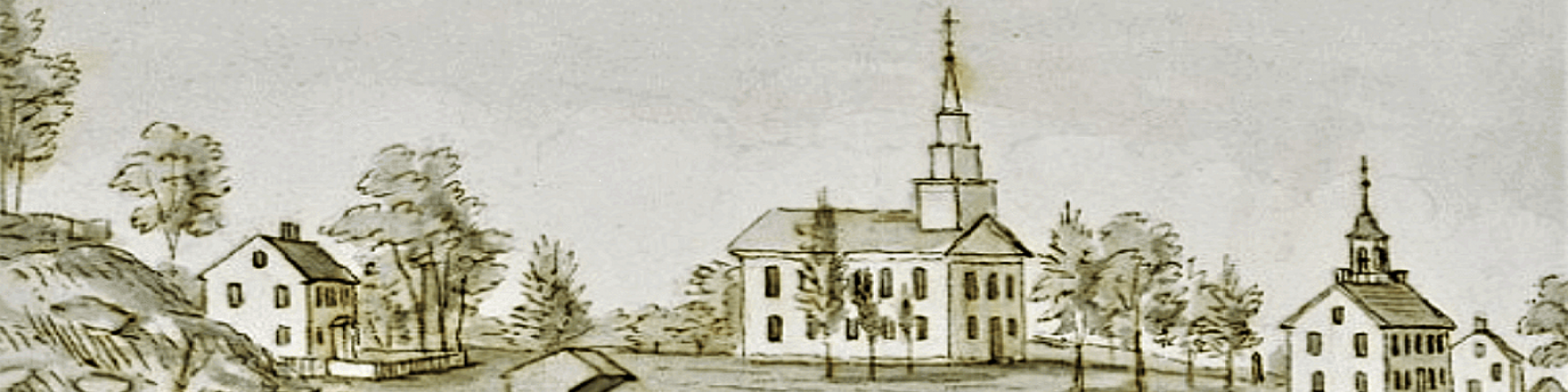

As a purveyor of local history, whenever I post a vintage photograph of a landscape from a hundred or more years ago there are usually several comments about how different the countryside appeared. Unlike today, there were views of the distant vista across many of the wide valleys that separate the long, north-south ridges that make up much of Connecticut. It soon becomes obvious that large areas of land had been clearcut, but other than clearing the land for the purpose of creating farmlands, why had so much of Connecticut’s forestlands disappeared by the middle of the nineteenth century?

According to the Connecticut Statewide Forest Resources, when the first colonists arrived in Connecticut in the mid-1600’s, they found most of the land covered by forests. But it wasn’t all old-growth forest, and much of it wasn’t all that difficult to travel through.
While the indigenous peoples of North America kept no written documents of their history, over the years, archaeologists have discovered artifacts and historians have carefully pieced together the written words of early European explorers and settlers that suggest that Native Americans carefully managed their forests long before the first European ships arrived on these shores. Unlike most of the forest land in Connecticut today, there weren’t many dead trees littering the ground nor vast entanglements of wild vines and shrubs that impeded the movement of men or wild game. Some early records indicate that much of the forestland was more “park like” than wild when it was first encountered by the Europeans.
The wild swings in temperatures between summer and winter were just as difficult to deal with by the indigenous population as they would have been by newer arrivals from Europe. By the mid-1500’s many of the Native Americans were living in permanent settlements and growing crops to sustain themselves through the long months of winter.
By then, they were also using the trees in the forest to construct permanent shelter. In the late 17th century Roger Williams, founder of the Providence Plantation, explained how Narragansett Indians constructed their buildings: “They gather poles in the woods, and put the great end of them in the ground…and bendinge the topps of them in the forme of an arche, they bind them together with the bark of walnut trees, which is wondrous tough.”

The natives were then growing corn, squash, and other domesticated plants on the tracts of land that they had cleared. Their tools weren’t as sophisticated as their European counterparts, so they often used fire to clearcut the land needed for cultivation.
Native Americans also used fire to better control the habitat of the forest by the burning of nuisance plants to allow more desirable bushes containing fruits such as blackberries and blueberries to thrive. Those plants provided nutrition not only to themselves, but to wildlife such as deer, wild turkeys, partridge, and pheasants; all of which were hunted for food.
Early interaction with the Europeans took its toll on the Native American population, as they were suddenly exposed to new diseases that they had no immunity to fight. As their population declined during the seventeenth century, the abandoned lands they had previously cleared and cultivated quickly became reclaimed by mother nature.
As the European settlers moved further inland during the latter part of the seventeenth and the early years of the eighteenth centuries, they found much of that land was then covered with new growth. The need to clear enough land to grow crops and provide pastures for raising livestock was then again in play. But those forests weren’t simply a nuisance to those who wanted to farm, they were also a valuable source of fuel and building materials for a new generation of farmers.
By 1825, the amount of forested land in the colony had dropped to about twenty-five percent.
The European settlers brought cattle, sheep, and swine with them to North America. They didn’t want to rely on hunting alone to provide their families with sustenance. But raising animals meant clearing land for pastures for summer grazing, and planting crops such as corn and oats to feed their animals during the winter. In addition, they needed to clear the land of native trees to plant their orchards of apples, pears, and peaches. The typical self-sustaining European farmer likely needed four or five times as much land as the Native Americans had used for similar purposes.

Two hundred years ago, getting ready to survive a New England winter would have required hundreds of hours’ worth of work just to build a large enough reserve of firewood to keep the house warm. The typical twenty-foot by twenty-five-foot early saltbox home with a center stack stone chimney containing three fireplaces would require as many as thirty to forty cords of firewood to last the entire year. In 1824, that meant felling the needed trees by hand – either by axe or by using a two-man saw. Once down, the tree would typically need to be cut into 24-to-30-inch labor-intensive lengths and then split with an axe to make it manageable. A typical ten-inch diameter mature tree (20 years old) would produce about a fifth of a cord of firewood, meaning the average household would require between 150 and 200 average size trees each year just to supply enough fuel for the heating and cooking needs. Older growth forests could supply more wood per tree, but thicker, taller trees also required more effort to fell, cut, and split.

Homes built 200 years ago lacked any insulation. The doors and single-pane windows were drafty and ill-fitting. A typical stone fireplace from the late 18th and early 19th centuries was also incredibly inefficient, losing as much as ninety percent of the heat generated in the firebox to the sky above.
While firewood would have been readily available during the process of clearing the land to make the fields, once those fields had been clearcut, farmers still needed to heat their homes. Probate records give us a good indication of where most of the local farmers harvested their firewood. Those records show many Easton’s farmers owned several acres of “wood lots” that were used solely to source firewood. In many instances, those lots were not contiguous to the main farm and meadows but were located nearby. Thoughtful harvesting of timber that included replanting of seedling trees could result in a good woodlot becoming a constant source of firewood for many years.
At the Historical Society of Easton, we have recently digitized several diaries of men who lived here during the 19th century. One man, Charles Judson Thorp – a teacher by profession – kept meticulous diaries that span over six consecutive years. They give us a clear picture of his day-to-day life. It is evident from Thorp’s writings that he spent part of each day for four to six weeks during each autumn working a nearby woodlot to harvest and then haul enough firewood to heat his family’s home for the winter.
The deforestation of Connecticut continued unchecked throughout most of the 1800’s. Wood was the primary source of all building materials prior to the latter half of the nineteenth century. Houses, barns, furniture, barrels, wagons, and even bridges were all made of wood.
When the railroads came, the track that carried them was made of steel, but the ties that held those tracks in place were all made of wood. As many as a million railroad ties were needed for every 350 miles of track that was laid. Throughout most of the century, locomotives used wood fires that heated the water in the boiler, turning it into the steam that powered the drive wheels.

Prior to the discovery of large amounts of coal in the Appalachians, charcoal was a major source of energy in many industries. The production of charcoal was a labor-intensive process that required anywhere from five to ten cords of wood to produce a single ton of charcoal. Charcoal was used by blacksmiths, bakers, and any other industry that required an evenly hot, bright fire that emitted little smoke. Even as steel beams began to replace wood in some construction, the production of that steel required the extreme heat that was provided by burning charcoal.

Even as great fires destroyed large portions of many towns and cities, the brick and concrete structures that replaced those previously constructed solely of wood still required large quantities of firewood to heat the kilns that produced the lime used in cement. A typical limekiln, like the size used in neighboring Redding, would have required between five and ten cords of wood per day to produce enough heat.
Ironically, it was the growth of industry and the eventual change over to fossil fuels – oil, gas, and coal – that led to the gradual reforestation of Connecticut. Viewing the landscape of Easton from the air in the Connecticut Aerial Survey of 1934, one can see how much of the town remained open shortly before WWII. But a closer look at some properties in the trees will show some of the old stone walls that were built when that land had been cleared for farming a hundred years earlier. The transitioning back to forest land was already well underway.

Today, slightly more than sixty percent of Connecticut’s land is again covered by trees. One can only wonder what our landscape will look like in another one hundred years.
